
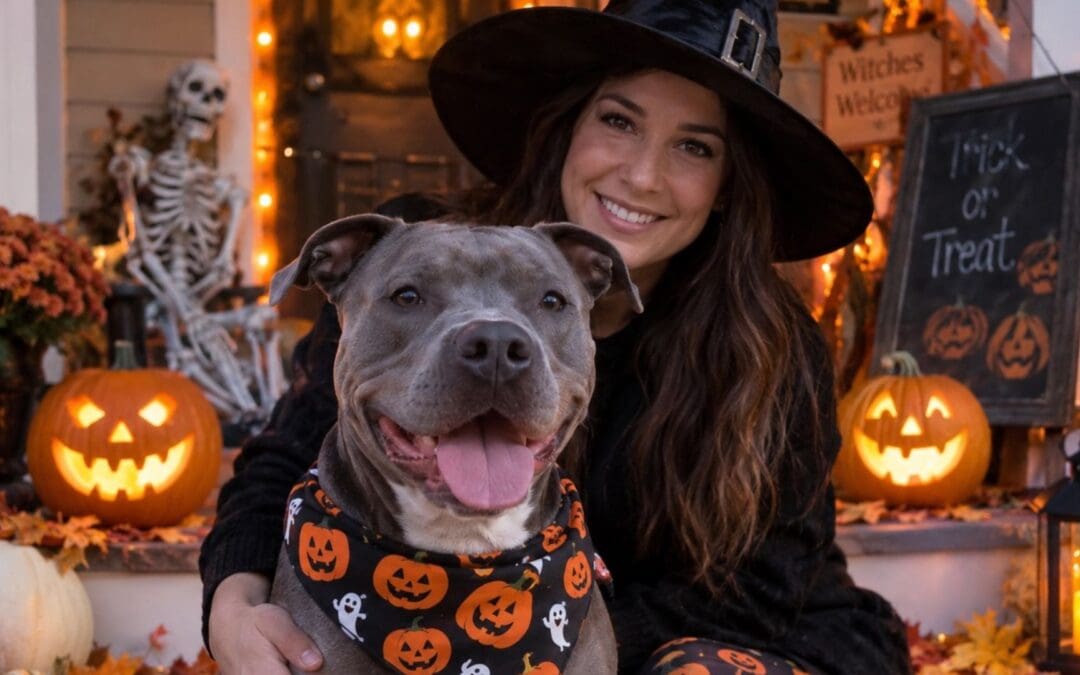
Halloween is a strange night for dogs. From their side of the door, the sequence goes like this: the doorbell rings every ninety seconds, strangers appear in shapes that aren’t people-shaped, everyone shouts, and this continues for three hours.

For a confident dog who’s lived with you for years, it’s an annoyance. For a dog who moved in six weeks ago, it can undo a month of progress.
Here’s how to get through it.
Make a plan before the sun goes down
The single best decision is to remove your dog from the front door entirely. Not as a punishment. As logistics.
Set up a back bedroom with her crate or bed, water, a long-lasting chew, and something with white noise. A fan, a TV, a playlist. The goal is to blunt the doorbell, not to drown it out.
Put her there before trick-or-treaters start, not after she’s already worked up. Once a dog is over threshold, the quiet room is damage control instead of prevention.
Handle the door, not the dog
If you’re giving out candy, sit outside with the bowl or turn the porch light off. Every ring of that doorbell is a repetition teaching your dog that the doorbell means chaos, and you’ll be undoing that in November.
Keep a leash on her if she’s anywhere near the front of the house. Halloween is one of the highest-volume nights of the year for lost dogs, and the reason is almost always an open door.
Check that her collar tag is current and her microchip registration has your actual phone number on it. Do that today, not on the 31st.
The candy problem
Chocolate and xylitol are the two real dangers. Xylitol shows up in sugar-free gum and candy and is significantly more dangerous to dogs than chocolate. Raisins are also toxic.
Practical version: the candy bowl lives on a counter your dog cannot reach, wrappers go in a lidded trash can, and the pillowcase full of candy does not spend the night on a kid’s bedroom floor.
Know where your nearest emergency vet is before you need it. Program the number.
About costumes
Some dogs genuinely don’t mind. Most tolerate it. A few find it deeply unpleasant and can’t tell you.
The test is simple. Put it on, watch for thirty seconds. If she freezes, tucks her tail, licks her lips repeatedly, or tries to back out of it, take it off. A bandana counts as a costume.
Never leave a costumed dog unsupervised, and check that nothing restricts her mouth, ears, or eyes.
If your dog is reactive, skip the whole thing
There’s no prize for making a nervous dog sit through Halloween. Take a long walk in the late afternoon, feed dinner early, set her up in the back room, and let the night happen without her.
A dog who isn’t ready for trick-or-treaters isn’t a dog with a problem. She’s a dog who’s been in your house for a few weeks and hasn’t yet learned that any of this is survivable. Give her the easy version this year. Next year will be different.
Worth saying out loud
If you’re reading this because you just adopted and you’re worried about how she’ll handle it, that worry is a good sign. It means you’re paying attention to the dog in front of you rather than assuming she’ll be fine.
That’s most of the job.
See our training resources → kenneltocouch.org/training-videos/
Recent Comments